Short Summary
It is not a matter of big brands or marketing hype; rather, it involves project execution, client feedback, and the builder’s real-life experience.
People who do not verify this aspect usually face problems related to delayed possession or unresolved issues even many years after registration. The blog indications distinguish competent builders from average ones in terms of legal compliance, project development, and post-sales service, enabling buyers to choose reputable builders based on facts.
Find out why LML Homes stands out in the real estate world.
Why Trusted Developers Matter More Than a Good-Looking Brochure
Delivery of the project, reviews from the customers, and experience of the developer reveal much more about him than any advertisement will ever do.
A reliable developer not only sells a flat but also guarantees its quality even after the deal is made by delivering the project on time, communicating openly, and providing assistance when needed.
The issue of identifying trusted developers is significant in view of the real estate market that favours confidence and where such confidence is easily created in a sales office.
Now that the number of developers entering fast-developing markets and initiating projects increases rapidly, it is more important to know how to recognise a truly reliable developer before investing in his project. This is especially important when comparing builders in Chennai and assessing their track record.
In other words, this problem is just as significant for first-time buyers as it is for experienced ones. First-time buyers lack a frame of reference for normal construction timelines or customer support and therefore tend to believe the ambiguous answers readily. They may also find it difficult to evaluate residential apartments in Chennai based on quality, location, delivery history, and long-term value.
Experienced buyers might already be familiar with delays and want to avoid them next time.
Regardless of whether you know it consciously or subconsciously, your checks remain the same; the only thing that varies is the level of confidence with which you do your checks.
What Distinguishes Trusted Developers from Regular Builders?
The difference between a trusted developer and a regular builder is rarely seen in brochures. A regular builder promises, while a trusted developer delivers.
A regular builder reacts to complaints, whereas a trusted developer prevents them from arising in the first place. It’s also not a matter of the size and advertising of a developer, since a small regional developer who delivers on time can be more trusted than a big advertised developer with delayed deliveries.
- Delivery History
The history of a developer is the best indicator of your future. The problem of delays persists across the industry; according to the survey in December 2023, 46.6% of projects were delayed. Of the total number of delayed projects in December 2023, 38.1% were delayed in the range of 25-60 months, 23.8% in the range of 1-12 months, and 23.6% in the range of 13-24 months, while 14.5% of projects were delayed over 60 months.
In this context, a developer with a proven, verifiable history of on-time delivery becomes important. Request information about the last three to five projects that have been delivered, their original dates of completion, and their actual dates of handover.
Even hesitancy to provide this comparison is a useful piece of information in itself because a reliable developer would normally not mind showing his or her credentials.
- Legal Compliance
Good developers do not just register themselves under RERA; they function within its ambit. The Real Estate (Regulation and Development) Act, 2016, mandates that developers need to deposit at least 70% of the buyer’s money in a special account for the project, limit advance payments to 10% of the value of the property before the agreement is signed, and give buyers the option to get their disputes resolved within 60 days through the RERA of the state.
It is always recommended to verify a developer’s registration number, cases pending against him, and previous penalties through the official website of RERA, project-wise and not company-wise, since there can be problems in one particular project, although the developer may have been clear on the other fronts.
- Customer Reviews
Is it possible to find a reliable developer through the reviews left by the customers? Indeed, yes, but you must interpret those reviews as patterns rather than through the rating system.
Every big developer will have a few complaints, and what you need to focus upon is whether those repeated complaints are about late possession, inadequate communication or issues following possession. Verify those complaints through the internet along with the official complaints of RERA and the discussions with the current residents.
- Project Quality
The reputable builders today prove their claims of the quality of construction through certification by third-party organisations.
Certification programmes for green buildings like IGBC and GRIHA require projects to be independently assessed on energy usage, water efficiency and material quality before issuing any certificate to LEED-certified buildings in India.
For example, save about 25-30% of energy compared to non-certified buildings. Irrespective of whether the project has a certification or not, find out about the quality controls and standards that the builder follows as well as the warranty periods for the structure, waterproofing and fittings.
- After-Sales Support
It does not matter if you trust a particular developer or not; your relationship with him/her will not end upon possession of the property.
Reputable developers will have customer service departments that help to resolve post-possession concerns and will honour defect liability periods and address maintenance concerns even without pursuing them persistently.
Just ask current residents about this point; it is one of the fastest ways to differentiate reliable builders from unreliable ones.
One important way is calling the developer’s customer support number before booking to know how a potential buyer’s questions will be answered.
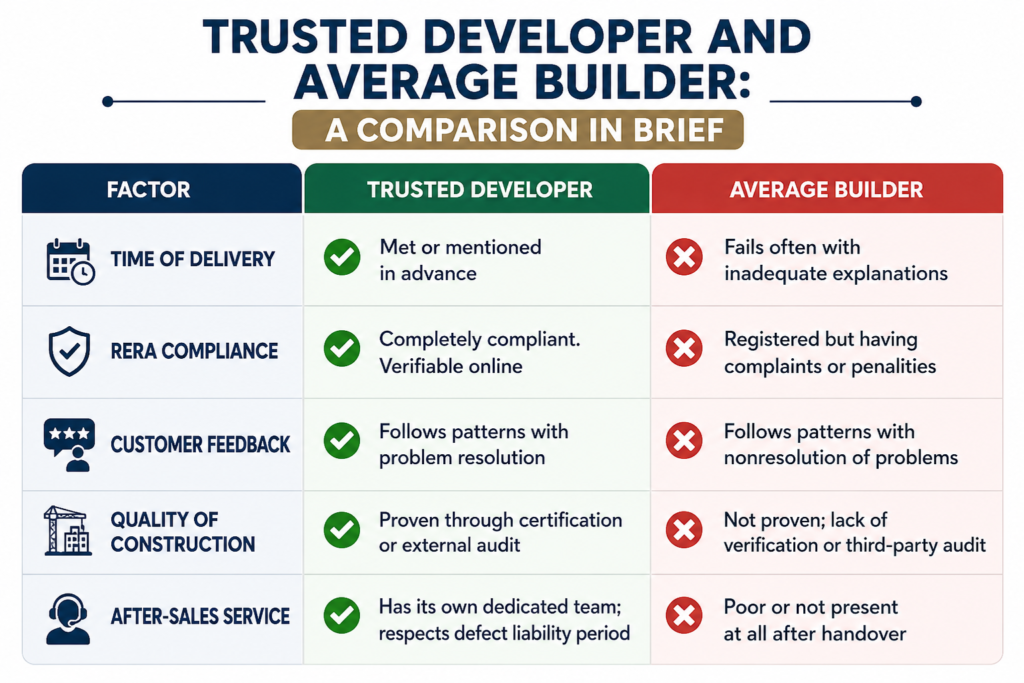
Trusted Developer and Average Builder: A Comparison in Brief
| Factor | Trusted Developer | Average Builder |
| Time of delivery | Met or mentioned in advance | Fails often with inadequate explanations |
| RERA Compliance | Completely compliant. Verifiable online | Registered but having complaints or penalities |
| Customer Feedback | Follows patterns with problem resolution | Follows patterns with non-resolution of problems |
| Quality of construction | Proven through certification or external audit | Not proven; lack of verification or third-party audit |
| After-sales service | Has its own dedicated team; respects defect liability period | Poor or not present at all after handover |
Buyers’ Mistakes When Judging a Developer’s Trustworthiness
Even the most careful buyer can become trapped by a few predictable mistakes while trying to evaluate a developer.
- Confusing a good reputation with efficiency
Not all reputable brands are efficient; big developers occasionally delay their projects as well.
- Looking through only the first few reviews
Most buyers don’t go further than the first page of reviews instead of looking for similar problems mentioned in other reviews.
- Neglecting the information about RERA cases
Not taking a few minutes to check if there are any cases or penalties against the developer.
- Assuming that the certification is always valid
Green building and quality certifications are usually renewed every three to five years.
- Not asking about after-sales support from the beginning
Often, buyers learn about the attitude towards post-handover issues through personal experience.
- Taking only one visit arranged by the developer
An unplanned visit or a talk with people living in a project will give you more information than the visit arranged by the developer.
Expert Advice: How to Spot Reliable Developers Beyond the Marketing
Seasoned buyers evaluate the developer’s reputation much like a business reference check, in that they do their own evaluation instead of taking the information for granted.
This implies going to at least two of the developer’s past and completed projects and talking to people who have lived there for more than a year.
They will also need to find out whether the developer has several ongoing projects without having any money problems and interruptions in the construction process.
This will imply reviewing the whole page on RERA regarding the project and not just its registration number, as everything concerning its delivery period, complaints, and any other actions taken by the authority is available there to those who want to find out.
Why LML Homes Reflects What Trusted Developers Should Look Like
Trust is established with every completed project, and LML Homes strives for this standard at every one of its projects. Each LML Homes project is backed by RERA-compliant, independently verifiable delivery records and an after-sales team that keeps working even after handing over possession to customers.
Instead of relying on marketing, LML Homes focuses on providing quality projects with transparent customer communication and builder experience reflected in the feedback of the residents.
Home buyers who want to learn why they should buy their apartment from a reputed builder can explore the key benefits and considerations covered in our detailed guide. LML Homes follows the same principles of quality, transparency and reliability that buyers look for when choosing a reputed builder. @LML Homes – Trusted, Reliable Developers & Reputed Builders in Chennai
To wrap up: trust the Delivery Record, not the sales pitch.
Trusted builders are revealed by their delivery record, legal compliance, truthful customer reviews, verifiable quality of the project and after-sales support.
Average builders may try to copy the marketing material of a good builder; however, no amount of marketing can replace the 10-year-long history of timely deliveries and satisfied customers who would readily buy from a particular builder again.
If you are about to make your booking, test a developer against these five points instead of listening to his sales pitch.
See exactly why LML Homes is the trusted name that buyers return to.
Frequently Asked Questions About Trusted Developers
Q. 1. Who are the most trusted developers in Chennai?
The reliable developers of Chennai should be those who have a proven track record in delivering their projects, are RERA-compliant, and receive positive reviews from previous customers. The sales of houses and new launches in Chennai have been experiencing an upward trend over the past few years, and thus it is necessary to ensure that you go through the track record of each developer independently.
Q. 2. How can I verify the reliability of a developer?
One needs to see the RERA status and litigation track record of the developer on the state portal website, personally visit their project sites, talk to the people living there, and check their financial soundness by the number of projects delivered without delays due to financial issues.
Q. 3. Are customer reviews useful in identifying good developers?
Yes, but only after proper verification of these reviews. Look out for consistent comments throughout several review sites and then verify any critical comments from RERA complaint databases of the concerned developer or project.
Q. 4. Why do some developers delay projects?
Some of the common reasons are lack of funds, delays in obtaining government approvals, issues related to land acquisitions, and ineffective project planning. Reputed developers handle all these risk factors effectively due to their better financial strength and realistic planning of projects.
Q. 5. Which certifications should a builder have?
First and foremost, a valid RERA registration is mandatory for all their projects. Moreover, green building certifications like IGBC/GRIHA and quality certifications like ISO are definite indicators of a developer who is experienced and reputable.
Q. 6. How does a trusted developer differ from a reputed builder?
This is a very common confusion of terms because ‘reputed’ can also mean ‘well-branded’; however, a trusted developer would be someone who has been known to deliver, abide by the rules, and make their clients happy.
Q. 7. How much time does it take to find out about the reliability of the developer?
A moderately good checkup will take around one or two weeks, provided you do it in an unhurried manner.
Q. 8. Does the size of the project or the developer brand tell about the reliability of the developer?
No, because even large projects can get delayed. Size may hint at the financial strength of the developer, but delivery record and customer response count more than that.
Q. 9. Can a person be both a registered builder according to RERA and also be an untrustworthy builder?
Yes. The registration with RERA only proves the compliance of that particular builder for that project and does not give any indication of the quality of construction, quality of communication, or after-sales services.
Q. 10. What information must I gather personally from the developer?
Information about the previous three to five projects undertaken by the developer, dates on which they were handed over, registration numbers of RERA in those years, their after-sales policy, and references from existing customers.