Quick Summary:
Community living vs independent house is one of the toughest decisions that Indian property buyers have to make today, and this is dependent on the cost, safety, and lifestyle offered.
Community living offers the benefit of maintenance and safety as it is in gated communities, costing about ₹2-₹8 per square foot per month, while an independent house gives complete privacy and also provides land ownership and personal maintenance.
The increasing popularity of apartments among Indian buyers, with over 50 per cent of transactions being those of apartments today, clearly shows that buyers are increasingly comparing convenience to ownership a trend reflected in the growing demand for residential apartments in Chennai as well.
Why This Decision Matters More Than Ever
Modern home buyers do not simply compare prices anymore; they balance the choice between the lifestyle and the value of their purchase.
Community living or an independent house has been named one of the most frequently searched topics by first-time home buyers, and it is no wonder; according to a home buyer survey, about 64% of Indian buyers consider security one of the top three factors to be considered when buying a house, and high maintenance costs and changing family dynamics have completely redefined what the ideal house is.
You will not regret making this decision correctly; you will be haunted for years by making this decision incorrectly.
Community Living vs Independent House: The Basics
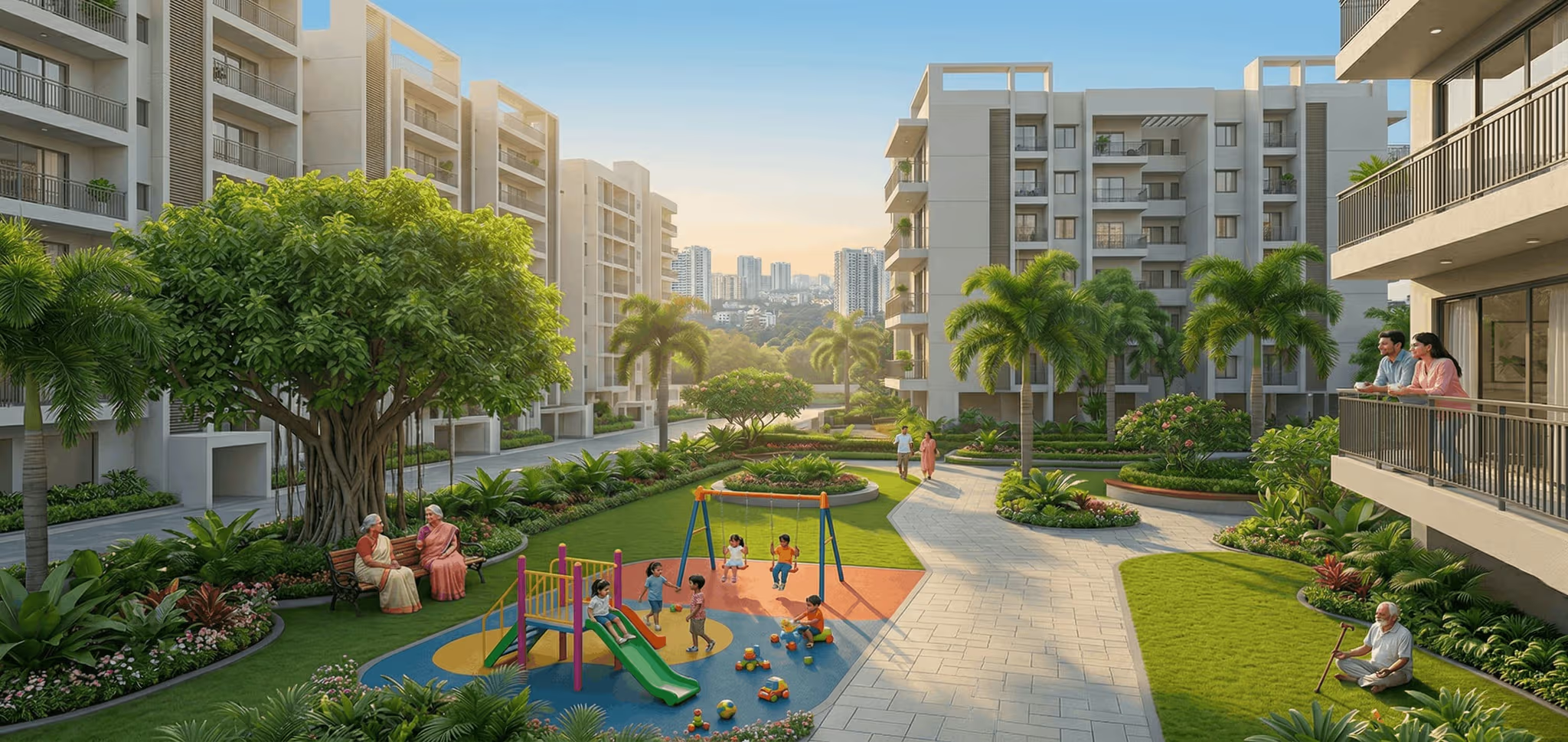
Apartment living within a gated community is associated with sharing amenities, management, and closeness to fellow inhabitants.
On the contrary, an independent house is an asset that is located in an individual plot having no shared walls or passages.
Although they fall under the residential category, the processes of ownership and inhabitation vary quite significantly from each other, and here’s some data to back up the above-stated argument: the number of apartment units within the overall residential sales accounts for more than 50%, a number that keeps increasing owing to urbanisation and lack of space in India.
Community Living in a Nutshell
- Shared facilities: gyms, parks, clubhouses, pools
- Managed by the resident welfare association (RWA) or facility management
- Fixed monthly maintenance charges
- Higher density of living with neighbours around
Independent House in a Nutshell
- Ownership of the whole land and structure
- No sharing walls or facilities
- Entirely own maintenance and repairs
- More freedom to renovate, build, and redesign
Living in Community Vs Buying an Independent House – Major Differences
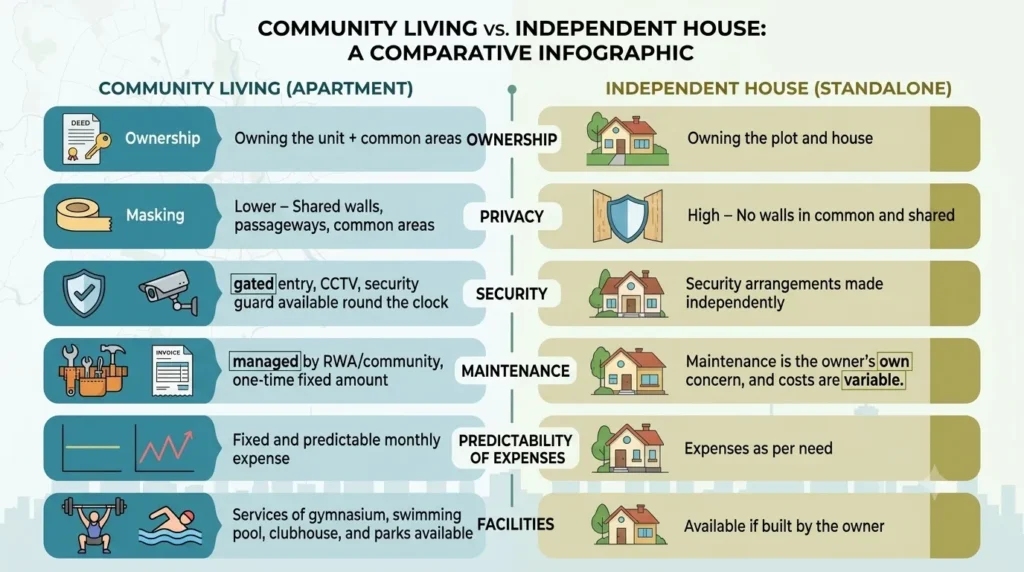
| Parameter | Community Living (Apartment) | Independent House (Standalone) |
| Ownership | Owning the unit + common areas | Owning the plot and house |
| Privacy | Lower – Shared walls, passageways, common areas | High – No walls in common and shared |
| Security | gated entry, CCTV, security guard available round the clock | Security arrangements made independently |
| Maintenance | managed by RWA/community, one-time fixed amount | Maintenance is the owner’s own concern, and costs are variable. |
| Predictability of expenses | Fixed and predictable monthly expense | Expenses as per need |
| Facilities | Services of gymnasium, swimming pool, clubhouse, and parks available | Available if built by the owner |
Cost Comparison: Which Works Out Cheaper?
However, on paper, the cost may seem relatively lower owing to the absence of maintenance charges to pay. When you consider all other factors, however, this is not always true.
Maintenance of housing societies involves costs such as salaries for security, maintenance of lifts, garden maintenance, and electricity for common areas, and this usually comes at about ₹2 to ₹8 per square foot every month.
Thus, an individual with a 1,000 sq. ft. flat could be paying anywhere between ₹2,000 for a basic society and over ₹8,000 for an advanced one. This also differs according to the location; for example, societies in Bangalore and Delhi NCR vary between ₹2,000 and ₹10,000, while societies in Lucknow vary between ₹1,000 and ₹500.
An independent house requires more upfront costs, as the owner would have to pay for the plot and its construction independently.
This, thus, makes community living appropriate for people with predictable spending preferences and independent houses for people with higher expenditure limits.
Privacy vs Convenience: Weighing the Trade-Off
This is where the dilemma of community living vs independent house living becomes very personal. The independent house provides an incomparable level of privacy; there are no shared walls, no social gatherings, and full control over whom you want to let in. For people seeking peace, space, and privacy, this is usually the final point.
Living in apartments involves the sacrifice of privacy for the sake of convenience. All facilities are a few minutes away using elevators; there are security guards around the clock, and all household chores, such as garbage disposal and maintenance, are done by the management.
Considering the fact that safety is one of the top three factors in consideration for most Indians when buying homes, it is not difficult to understand why this kind of convenience tips the balance in favour of professionals and migrating individuals.
Maintenance Burden: Who Handles the Upkeep?
Another aspect that is often overlooked in making this choice is maintenance. In a community living arrangement, there is a facility team that takes care of everything from lift maintenance to landscaping, and all costs are incurred through the monthly fixed charge mentioned before.
All homeowners need to do is pay and forget about the details. A homeowner living independently will be required to take personal care of plumbers, electricians, painters, and gardeners whenever necessary.
Although this allows for more control, it also requires more effort from homeowners. Those individuals who travel a lot or don’t have enough time to deal with repair works might find it more difficult to appreciate an independent house.
Maintenance Checklist: Community vs Standalone House
| Task | Community living | Independent House |
| Security personnel cost | Included in the maintenance fee | Arranged separately by owner |
| Maintenance of common areas | Done by RWA | Not applicable |
| Repair works (plumbing, electricity) | Coordinated by the facility team | The owner’s responsibility only |
| Landscaping | Done collectively and covered in fees | Owner’s responsibility |
| Cost predictability | Fixed monthly fee | Varies as needed |
Resale Value: Which Property Appreciates Faster?
Resale price depends mostly on the locality, but there are several additional factors that make the position of independent homes somewhat better in regard to the appreciation of land.
Land is always a scarce and appreciated source, and the data from the Reserve Bank of India about the Indian real estate market show the same situation in regard to the shortage of land in urban areas.
An independent house at an attractive location in the developing area can provide the capital gains along with the development of the whole area.
At the same time, apartments in the attractive gated community close to places of employment will be sold faster than independent houses. The explanation for this is quite simple: there are more people interested in buying low-maintenance and secure property.
Family Suitability: What Works Best for Your Household?
If a young family or someone who values safety, access to common spaces, and social connections because of the nature of living in a gated community were to choose, they would certainly opt for apartment living that offers playgrounds and security systems for the kids, while a larger family with members belonging to different generations would definitely choose to buy a house with open space.
This is not necessarily the solution because there may not be any solution; it all depends on you and the various factors that make it convenient for you.Buyers’ Mistakes to Avoid
- Neglecting long-term maintenance expenses
The buyers consider only the buying cost and ignore repair and maintenance costs of several years.
- Ignoring the security needs
Selecting an independent house without keeping aside money for private security and surveillance cameras could prove expensive.
- Ignoring the resale analysis
Failing to conduct an investigation about the resale history of properties in the area in the recent years.
- Neglecting society regulations
Purchasing a property without prior study of maintenance cost, regulations, and RWA guidelines.
- Deciding based on looks
Impressing by looks without considering whether it suits the lifestyle requirements of the family.
Expert Advice
The property consultants suggest that first-time buyers and professionals should go for community living, considering the predictability of cost, security, and low personal maintenance. Independent houses should be preferred only when one is looking forward to staying long-term or planning to buy land and increase its value.
Why Buyers Choose LML Homes
Regardless of whether you prefer the comfort of community living vs independent house, LML Homes provides both and has two decades of expertise behind it ever since the company was founded in Chennai in 2005 under the Lucky Mercantile Limited group.
Being involved in RERA and CMDA-approved housing projects in the Tambaram, Kattupakkam, Neelankarai, and OMR areas, LML Homes has managed to gain recognition for high-quality building, a clear pricing policy, and housing solutions that meet the needs of a whole family.
Whichever side you take in the debate, the LML Homes team will be able to help you understand all the aspects associated with the cost, maintenance, and value of each choice. also check this blog Gated Community vs Standalone Apartment
Final Thoughts
There is no right answer to the question of which one is better between community living and independent houses; there is only the answer that corresponds to your financial possibilities, family situation, and readiness to take care of the property.
Take an honest look at your preferences, explore both types of properties, find out what kind of maintenance is really involved, and pick the house that matches your real preferences.
Discover the apartments and independent houses from LML Homes in Chennai now.
Frequently Asked Questions for Community Living vs Independent House
Q. 1. Is community living vs independent house better?
There’s no clear answer to the question of which one is better when comparing community living and independent housing; everything depends on individual preferences. The apartment will be preferable for those who want more security and amenities and need less maintenance, and the independent house will work best for those who prefer privacy and independence.
Q. 2. Is community living cheaper than buying a house?
Community living tends to be cheaper when it comes to monthly predictable expenses, as the maintenance cost of ₹2-8 per square foot will be borne by all residents. Independent houses may not have any fixed cost, but they will definitely be costlier after considering the cost of repair work and security arrangements.
Q. 3. What are the long-term benefits of an apartment?
Apartment buildings provide you with security, shared facilities, easy resaleability due to high demand from buyers, and less involvement in maintaining the property in the long term.
Q. 4. Which one of them is safer?
Generally, community living tends to be safer because of the presence of gates, surveillance cameras, and security personnel on duty 24 hours a day and paid for by the maintenance fee; that’s why about 64% of Indian buyers of real estate consider security to be one of their primary concerns.
Q. 5. Which one appreciates more quickly?
Independent houses tend to appreciate at a higher rate owing to the component of land, whereas apartments that are well-located in amenity-filled societies have the advantage of selling faster owing to a larger number of buyers.
Q. 6. Is an independent house a suitable choice for a joint family?
Yes, the independent house is more suitable for the joint family, as it provides ample space and scope to expand the house when required.
Q. 7. What should I be prepared to pay for maintenance costs in a gated society?
The maintenance costs depend on the city and facilities, but always ask for the exact amount to be paid every month (typically ₹1,000 to ₹10,000 depending on the city and project).
Q. 8. Is it more difficult to sell independent houses than apartments?
The resale process can take a longer time because the buyer base is limited and localised as opposed to apartments, where the interested buyer base is wide.
Q. 9. Is life in a community environment safer for children?
Children can be considered safer in communities since there are areas designated for playing, restricted entry of vehicles into such communities, and security available all the time inside the community.
Q. 10. Is it possible to renovate and redesign my apartment like I would have done in the case of an independent house?
Absolutely not; renovations and remodelling are subject to a lot of constraints for an apartment as opposed to the liberty available for a house.