Short Summary
An encumbrance certificate is the proof of title clearance, legal documentation, and history of the property prior to your purchase.
An EC is necessary, as it can save you from inheriting an unpaid loan of someone else’s, a pending court case, or any other legal proceedings against the property you are unaware of.
The subsequent sections provide information on the importance of an EC, the number of years for which records have to be verified, the method of downloading an EC online, and what buyers’ mistakes cost.
Find out how LML Homes checks every EC before selling to you.
Why an Encumbrance Certificate Should Never Be an Afterthought
Title clearance, legal documents, and property history are all found in one single document – the encumbrance certificate. This is perhaps the most accurate means to verify that the property in question has no loans, claims, or legal entanglements hanging over its head.
The importance of understanding what an encumbrance certificate is is due to the fact that it may be the only document that stands between a buyer and a legal mess he/she didn’t know about.
The property can seem ideal – right location, reasonable price, cooperative seller – but still have a registered mortgage or pending litigation entry that becomes visible only when the buyer gets hold of the EC.
The issue is important since a majority of property disputes in India arise from ignorance of what the EC signifies.
For buyers exploring flats for sale in Chennai or luxury apartments in Chennai, checking the Encumbrance Certificate is an essential step towards making a secure and informed property investment.
What Is an Encumbrance Certificate and Why Does It Matter
This is a document issued by the office of the Sub-Registrar that captures all the dealings, be they sales, mortgages, gifts, leases, or claims on a piece of property for a certain period of time selected by the individual. It is like the financial and legal history of the property.
Nil EC simply means there are no dealings of the sort made on that particular property within the selected period, which is what everybody looks for in an EC.
There are three practical reasons why you should get the EC: it proves that the seller has the right to sell; it lets you know if there are any banks or lenders who have a claim on the property; and it makes sure you are not dragged into a legal battle that you did not initiate. Not doing this step does not eliminate your risks; it only delays when you learn about them.
How Many Years of EC Should You Check
This is the point at which many purchasers do not understand the meaning of due diligence. An instrument that has been registered will have a lifespan of 12 years from the time of its creation, which means that 13 years has been accepted as the normal minimum number of years for which a bank will ask when evaluating an EC.
In cases of resale of properties, old buildings, and other transactions in which there was some kind of chain of owners in the past, it is now becoming the norm to request a search for 30 years.
As a rule of thumb, a new project will require a minimum search period of 13 to 15 years, whereas an old or resold property should be validated for a total of 30 years.
How to Download an EC Online in Tamil Nadu
In Tamil Nadu, it is not mandatory to go to the Sub-Registrar’s office. Buyers can access the EC on the TNREGINET website hosted by the Tamil Nadu Registration Department by entering the property information correctly.
Steps Involved in the Process
- Go to the website www.tnreginet.gov.in and register yourself.
- Go to the Encumbrance Certificate tab and click Search / View EC.
- Enter the zone, district and sub-registrar office of the land.
- Enter survey details like village name, survey number, and subdivision number with plot number, door number or flat number, if any.
- Select the duration for which the EC is to be granted.
- Choose the period for which the EC will be issued.
- Complete the captcha, submit the form, and pay the relevant fees online.
- Download the EC once it is issued.
The online process in states that have computerised their records, such as Tamil Nadu, is usually done within 3 to 7 business days, while the offline process takes 5 to 10 business days when done in person at the sub-registrar’s office.
In case the transactions are not found online, there could still be a need to visit the Sub-Registrar’s office in person.
Common EC Mistakes Buyers Make
Even those who are aware that an EC is necessary usually miss out on some crucial details about it:
- Asking for too short a timeframe to be included in the EC Asking for just 5 or 10 years when the risk is much older than that.
- Lack of a check for release deeds: If the EC indicates any history of a mortgage, it should be verified by means of a subsequent release deed.
- Using an old EC, an EC produced a few months ago, rather than asking for a new one close to the purchase date.
- Incorrect information about the survey or owner, inputting the survey number or owner name incorrectly.
- Using EC as the sole document to be considered, not considering other documents such as title deeds, mutations and pattas.
Encumbrance Certificate vs Patta: What’s the Difference
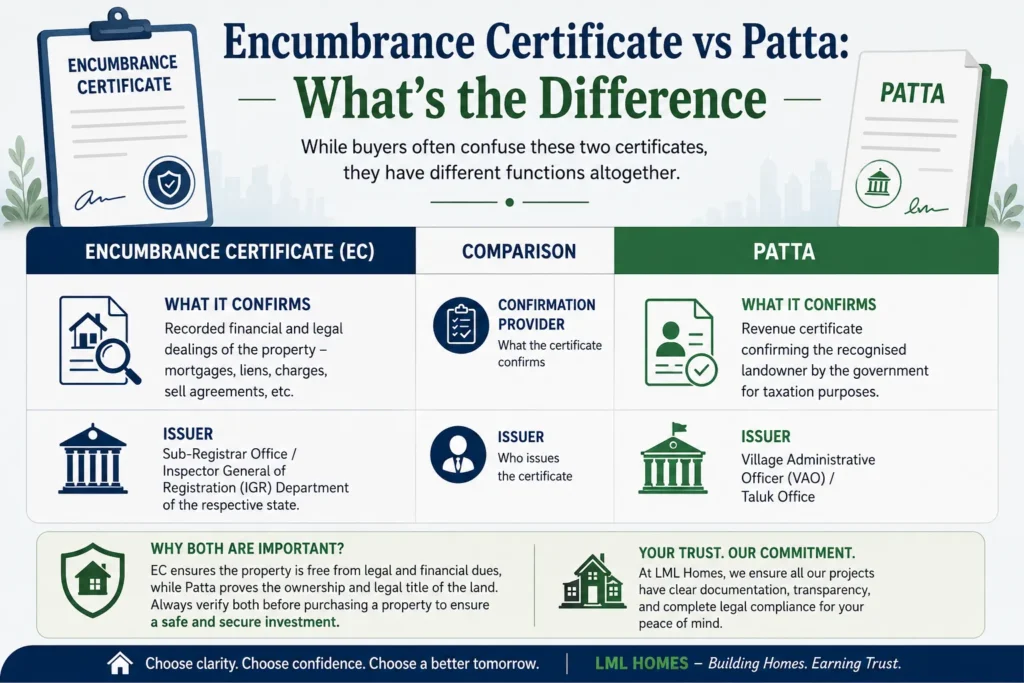
While buyers often confuse these two certificates, they have different functions altogether.
| Certificate Name | Confirmation Provider | Issuer |
| Encumbrance Certificate (EC) | Recorded financial and legal dealings of the property – mortgages, liens, etc. | |
| Patta | Revenue certificate confirming the recognised landowner by the government for taxation purposes | Village Administrative Officer / Taluk Office |
The Patta certificate confirms the recognised landowner according to the revenue records of the government; it does not confirm the existence of any mortgage on the property.
Conversely, the EC certificate provides information about any mortgages and/or liens without establishing any facts of ownership of the property. Both are required to obtain complete information about the status of the property.
Hidden Liabilities an EC Can Reveal
However, the true worth of an EC becomes evident through discovery more so than affirmation. In an extensive EC search, one may uncover such issues as:
- An outstanding mortgage on the property that the seller has not mentioned
- A case of court attachment or entry of litigation
- A prior sale that has not been registered, thus leaving a complicated trail of ownership
- Outstanding dues against the property that the bank or financial institution has secured
- Claims of co-ownership or inheritance that might emerge from family members who are not a part of the present sale
All of these issues, if found out after payment, can create an entire legal battle.
Buyers’ Mistakes to Avoid With Property Ownership Verification
As far as assuming the property is in good condition and therefore does not require an EC:
- Relying on the assurance of the seller instead of the EC
A seller saying there is no loan on this property does not make the EC redundant.
- Avoiding the EC because of a reputable developer
Even reputable developers can have units/sections in their projects that still have some historic information to clear out.
- Not checking if the EC is real
Getting certificates from unofficial third parties instead of using the official government portal may give you wrong or outdated information.
- Disregarding the EC for inherited or transferred property
Such property often has the most complicated history and requires the longest period for searching.
Expert Advice: How Property Lawyers Approach an EC
The lawyers who work on property law are not likely to treat the EC as a separate validation. The document is analysed together with the title deed, mutation, and Patta to ensure that the ownership history is traced through all four documents.
If there is a record of a mortgage in an EC, the lawyers will ask to see the release deed entry closing it rather than simply take the seller’s word that the loan is paid off.
For resale or older properties, buyers should pay close attention to the property’s legal history and ownership documents. Choosing a reputed builder can provide greater confidence in the documentation and legal processes involved, which is one of the 7 reasons why you should buy your apartment from a reputed builder.
Why LML Homes Makes Encumbrance Verification a Standard Practice
Ownership proof shouldn’t be something you have to go chasing for yourself; that’s how LML Homes operates on every project they do.
Every LML Homes property is equipped with an encumbrance certificate guarantee that is verified based on the recommended search period, from title deeds, pattas, and registrations, before even one unit is sold.
This is not something that you get as a perk; this is something that LML Homes makes sure of before selling you their property. For those of you looking for real property ownership verification, you’ve found it right here.@ LML Homes Check Out Our Reel
To Wrap Up: Don’t Buy Without It
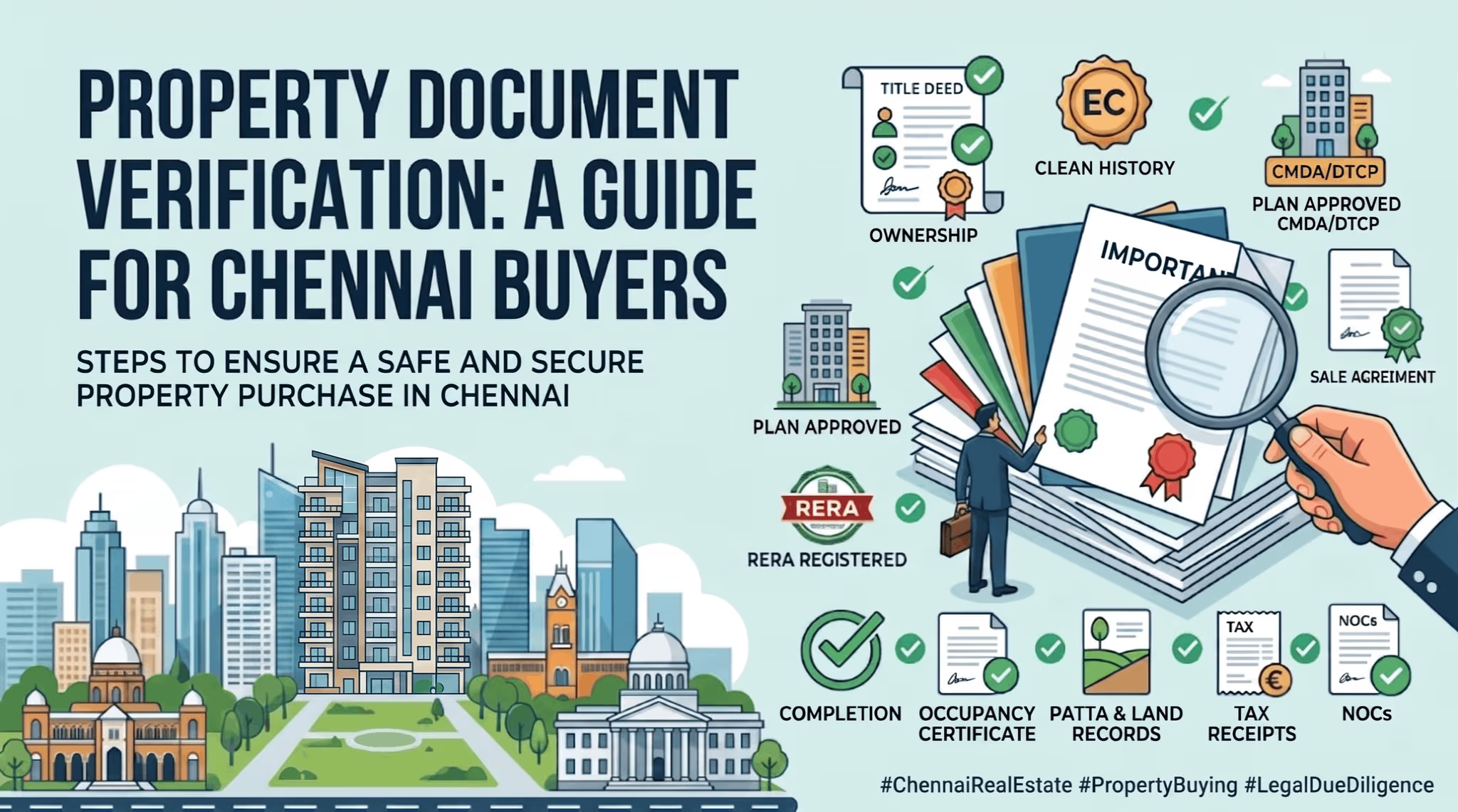
The encumbrance certificate is an important document when verifying a property’s legal history. Understanding how to verify property documents in Chennai can help you check for registered transactions, existing encumbrances and other details before proceeding with a property purchase.
Proper verification of the EC, checking title clearance, and property history for the correct period in relation to the Patta and title deeds are what differentiate a safe purchase from a hazardous one. If you skip this process, you are blindly purchasing the property
Frequently Asked Questions About Encumbrance Certificate
Q. 1. What is an Encumbrance Certificate?
The encumbrance certificate is an official document issued by the sub-registrar’s office which records all the transactions made related to mortgages, sales, liens, or any other claim on the said piece of land for a specified period, thus proving that the land does not have any liability on it.
Q. 2. Is EC mandatory while buying property?
Not mandatory from a legal point of view to complete a purchase, but it is a compulsory condition de facto. The banks need the same prior to approving the loan for purchasing a property, and the buyer runs a risk of inheriting certain burdens on that property.
Q. 3. How do I get the EC in Tamil Nadu online?
On the TNREGINET (tnreginet.gov.in) website under Encumbrance Certificate, one has to input the zone, survey number, and sub-registrar of the property.
Q. 4. For how many years is EC verification needed?
The banks generally prefer to verify a minimum of 13 years; however, if it’s a resale property or an old building, then it’s advised to do a 30-year check.
Q. 5. Is there a possibility of buying land without having EC?
Yes, there is; however, this could lead you into problems which can become very expensive once you have paid the price. Without EC, you don’t have any proof that your property doesn’t have any pending mortgages, disputes or other dues that would surface later on.
Q. 6. What is meant by Nil Encumbrance Certificate’?
A Nil EC certificate means that no registered transactions, mortgage loans, or legal cases have been found in the specified period for which you have applied for it. It is the output buyers and bankers look forward to.
Q. 7. How long does it take to obtain EC through online application?
If the state has a digitised system in place, an online EC can be obtained within 3 to 7 working days. In case of an offline process done through the sub-registrar, it takes roughly 5 to 10 days of work.
Q. 8. What do I do if the EC has a history of mortgages before?
Check whether there is any release deed which declares that the mortgage is discharged. In case of its absence, then one can treat it as an unresolved liability.
Q. 9. Are the EC and the title deeds the same?
The answer is no because title deeds are given in order to provide evidence of ownership of the property, while the EC provides evidence of transactions and liabilities of the property. Both are essential in purchasing the property.
Q. 10. Is it possible that an old property would have an unfinished EC?
The answer is yes, as some old properties may have partially digitised ECs, particularly for transactions made before the computerisation era. In this situation, it may require you to search for old records manually in the sub-registrar’s office.