
Short Summary
The vast majority of the major blunders that biggest mistakes first-time home buyers make are borrowing errors and legal verifications missed in the rush.
Your dream house can fast become a nightmare if you borrow too much, neglect the legalities of buying, and fail to plan for costs besides the price of the property. Below is how you can ensure your first purchase is built on a good foundation through the tips only real first-time buyers know.
Allow LML Homes to take you through your first purchase experience with trusted builders in Chennai, offering quality homes and reliable guidance at every step.
Introduction: Why First-Time Buyers Are More Vulnerable to Costly Mistakes
The biggest mistakes first-time home buyers make are where they typically go awry on the first purchase, and these don’t occur due to carelessness but rather due to a lack of advice on what needs to be checked out.
Knowing what mistakes buyers tend to make when purchasing their first property is important since it takes much less experience and emotional investment to make a first purchase than to make any subsequent property-related decision.
Since there are no previous transactions to gauge against, buyers tend to take a builder’s offer, a bank’s loan, and even a final price.
Emotional Buying: When the Heart Overrules the Budget
Buying into the allure of the beautifully designed model flat, view, or ‘last unit at this price’ offer is one of the most common newbie mistakes.
Emotional buying influences people to stretch themselves financially, seek no other opinions, and make hasty decisions that would not be made for any other kind of major purchase.
Houses are a long-term financial investment; allowing yourself a minimum of 48 hours of breathing space before signing on any dotted lines could save you from making rash decisions.
Overborrowing: Borrowing to Your Maximum Eligibility Limit
Why Do Banks Approve Loans Above the Amount You Should Borrow?
The banks measure your eligibility for taking out a loan based on the Fixed Obligation to Income Ratio (FOIR).
The FOIR generally allows loans of 40% to 60% of the gross monthly income based on your salary. What the banks approve is what you can repay, not what you can live with comfortably.
Safer Personal Benchmark
Most independent financial planners advise you to keep your aggregate EMI around 25-35% of your take-home pay, and the research done by the industry has found that a ratio of your EMI to income more than 50% would be financially unaffordable despite being sanctioned by the bank.
Getting the maximum loan possible from the bank leaves no money for any contingencies, retirement plans, or educational funds for your kids, which are commitments ignored by the bank calculations.
A Simple Guide
The 20-30-40 rule is the popular standard followed by first-time home buyers; the buyer tries to ensure a minimum 20% down payment, keeping his/her EMI not exceeding 30% of their income and making sure his/her total financial commitments (EMIs included) don’t exceed 40% of their income.
Avoiding Legal Due Diligence: A Costly Oversight
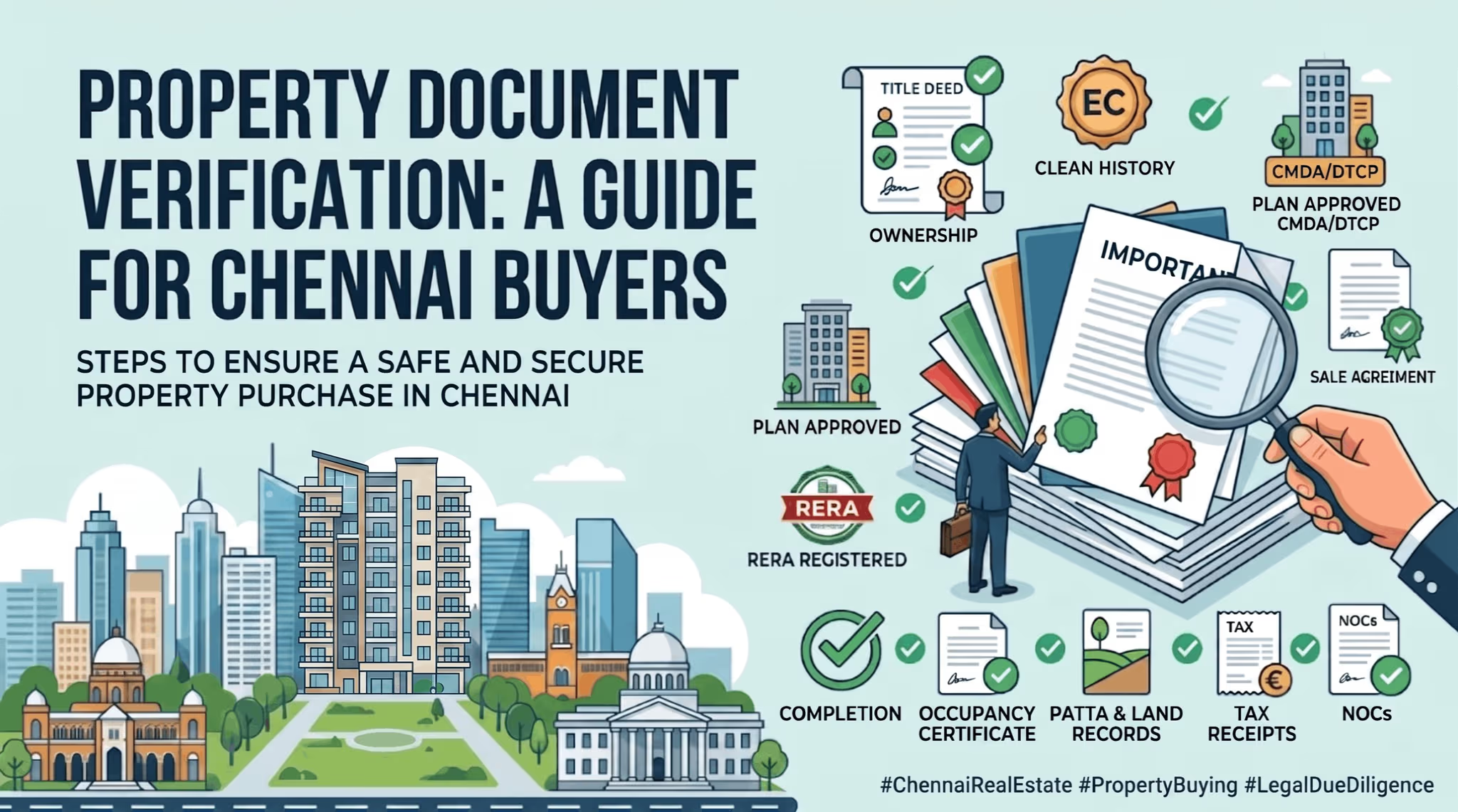
The biggest mistake first-time homebuyers make is not checking whether or not the property holds up to its legal requirements. This is one of the most common mistakes made by new home buyers, mostly since it ‘seems fine’ and the legal procedure is just a mere formality. Before committing to any contract, a buyer needs to verify:
- RERA registration, ensuring that the project is duly registered and is accurately displayed in the state portal.
- An Encumbrance Certificate (EC) ensures that the property is not tied up with any previous mortgages or claims and covers a period of at least 13 years or 30 years in case of an old or resale property.
- Ownership title and chain of title ensure that the seller holds a valid and legal right to transfer ownership of the property.
- Plans of the buildings are approved by authorities, ensuring that the construction is according to the approved plans.
Even missing one of these checks could lead to a multi-year battle in courts instead of a simple transaction, and unlike a mistake of lending money, a legal issue will affect the property rather than the money you have lent.
Choosing the Wrong Location for the Wrong Reasons
First-time buyers normally base their choice of location purely on the current price, with no consideration for any future factors like connectivity, infrastructure plans, resale value, or proximity to their workplace/schools.
Cheaper homes in poorly connected places can actually become costlier in terms of commute time and resale depreciation compared to slightly costlier properties located in better-connected locations. Prior to making a choice, one should consider future infrastructure plans for that place, see how much that place has grown over the last five years, and view it during different times of day.
Hidden Costs Which First-Time Home Buyers Fail To Factor In
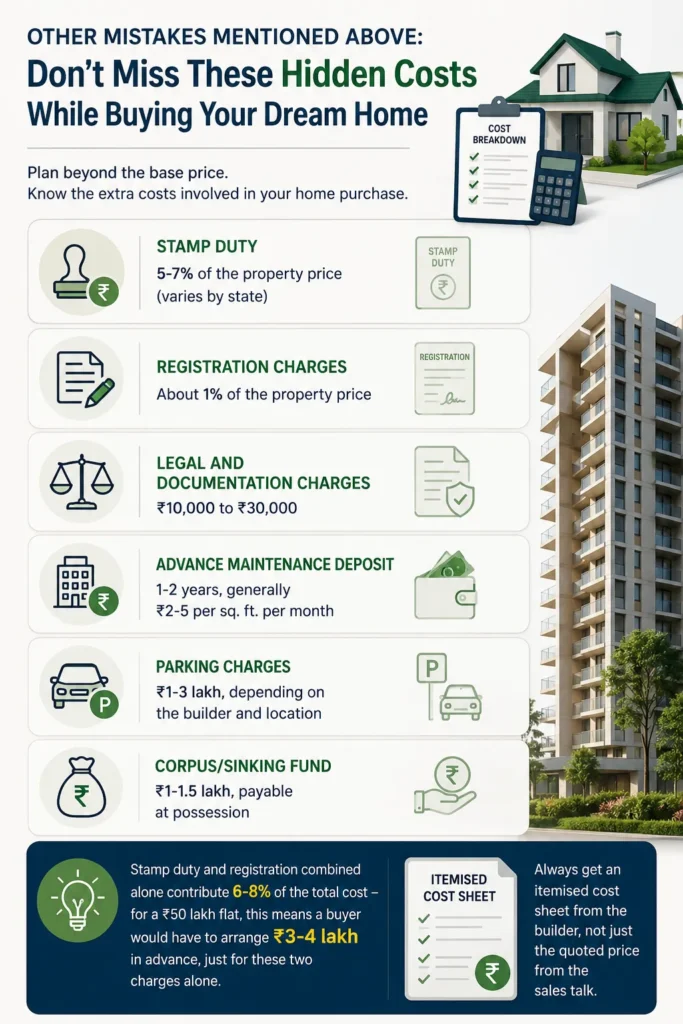
The biggest mistakes first-time home buyers make come as a surprise to first-time buyers more than any other mistake mentioned above.
- Stamp Duty: 5-7% of the property price (varies by state)
- Registration Charges: About 1% of the property price
- Legal and Documentation Charges: ₹10,000 to ₹30,000
- Advance Maintenance Deposit: 1-2 years, generally ₹2-5 per sq. ft. per month
- Parking Charges: ₹1-3 lakh, depending on the builder and location
- Corpus/Sinking Fund: ₹1-1.5 lakh, payable at possession
Stamp duty and registration combined alone contribute 6-8% of the total cost – for a ₹50 lakh flat, this means a buyer would have to arrange ₹3-4 lakh in advance, just for these two charges alone. Always get an itemised cost sheet from the builder, not just the quoted price from the sales talk.
Buyer Mistakes: First-time buyers must not make
- Making emotional rather than logical decisions
Not taking time off for a cool-down or visiting the site twice before making up your mind.
- Taking the maximum amount offered by the bank as affordable
Loan eligibility is not necessarily affordability.
- Considering legal work optional
Thinking that RERA registration or a good-looking site precludes the need for EC and title checks.
- Ineffectively estimating total cost
Failure to consider stamp duty, registration fee, and maintenance deposit costs because only the sale price is considered.
- Failing to compare loan offers with other banks:
Agreeing to the terms of the first bank without looking into interest rates and processing fees at other banks.
Expert Guidance: Tips Followed by Experiential Buyers for Their First Real Estate Purchase
The common practice of experts in guiding first-time buyers always includes one tip: separating your affordability from the loan amount that the bank can provide and building that gap from the very beginning.
Experts suggest keeping aside some emergency funds in addition to the total expenses for at least three to six months instead of spending their entire savings on a down payment.
Furthermore, they suggest asking for a detailed and itemised cost sheet before booking and not after booking, as it is always easier to negotiate or back out before paying than after making the payment.
Most of the time, expert buyers prefer getting the project registered independently even if it is already registered with RERA.
Why LML Homes Supports First-Time Buyers Through Every Step
First-time home buyers can avoid many common pitfalls by understanding the biggest mistakes first-time home buyers make and taking the right steps before making a purchase. With proper guidance and clear information from the beginning, LML Homes helps buyers approach the home-buying process with greater confidence.
At LML Homes, each project is accompanied by an itemised cost sheet, RERA registration and an encumbrance certificate, and assistance in budgeting based on reality and not the maximum amount of money that a bank can lend you. At LML Homes, it is thought that a first home purchase should be made to build financial security and not cause more trouble than help.
Positive Customer Experience: Rajalakshmi R shared a positive review about her experience with LML Homes, highlighting the team’s responsiveness, professionalism, guidance throughout the home-buying process, organisation, and quality of the project.
“We are delighted to have found our dream home at LML Homes. The team was responsive to all our queries and guided us throughout the process with professionalism. Everything was well organized, and we’re truly impressed with the quality of the project.”
— Rajalakshmi R | Google Review
To Wrap Up: Biggest Mistakes First-Time Home Buyers Make
Legal verification is an important part of buying a property, and buyers should know which documents to check and how to verify them before proceeding. Learning how to verify property documents in Chennai can help you identify potential issues with the property’s ownership, approvals or legal history before making a purchase.
Create a budget based on your actual take-home salary, not your bank loan eligibility; check whether the company has RERA registration and an encumbrance certificate; and always ask for the complete cost sheet.
When purchasing their first house through this approach, people are setting the right foundation and making every future property-related decision right. Not one that they’ll be forced to fix in the coming years to come.
Frequently Asked Questions About biggest mistakes first time home buyers make
Q. 1. What are the mistakes made by first-time homebuyers?
Some of the common errors made by new homeowners include buying based on emotions, opting for the highest loan sanctioned by the bank instead of something that is truly affordable, overlooking necessary legalities like RERA and EC, picking a location purely based on its cost, and not considering additional costs like stamp duty and maintenance deposit.
Q. 2. How much should I pay for a home?
According to experts, keep your EMI between 25% and 35% of your take-home salary, not the recommended 40% to 60% of your bank.
Q. 3. Is there any problem associated with borrowing to your maximum limit?
Yes, banks judge your credit limit depending on your ability to repay instead of living comfortably. Anything beyond an EMI-to-income ratio of 50% is deemed unmanageable, assuming that the financial institution itself sanctions the amount of money.
Q. 4. Do I need to engage a lawyer before buying a flat?
Yes, an independent lawyer would be able to validate the title deed, validate the encumbrance certificate, validate RERA compliance, and check the terms of the sale agreement, none of which would be offered proactively by the sales team of the builder.
Q. 5. Which additional costs usually shock buyers?
Costs like stamp duty (generally between 5 and 7% of the value of the property), registration fee (around 1% of the value of the property), advance maintenance charges, parking fees, and corpus fund contributions are the ones buyers tend to ignore.
Q. 6. How much should I save up for my down payment?
A popularly suggested benchmark would be a minimum of 20% of the value of the property, besides having separate savings for the purpose of paying stamp duty and registration.
Q. What is FOIR, and why is it important?
The fixed obligation to income ratio (FOIR) is the tool that is used by banks to determine the maximum amount of EMI that can be sanctioned based on your income and current liabilities. It determines the eligibility for a loan but not your personal need or requirement.
Q. 8. Under-construction vs. ready-to-move-in property: which one should I go for?
Both have pros and cons: under-construction property is usually less expensive but involves the risk of delay in delivery of the property, while ready-to-move-in properties involve higher costs but will provide you with the opportunity to view the actual property. It is up to the individual to make an informed choice based on his loan tenure and urgency.
Q. 9. How can I avoid emotional buying?
Take some time out and do not decide instantly; wait at least 48 hours; visit the property at least twice and compare it with one or two other properties before taking the final call.
Q. 10. What documents should I examine before booking my first home?
It is recommended that you, at least, examine the documents for the following: the RERA certification, the encumbrance certificate, the title deed, the approved plan for construction, and the payment schedule for the builder.