Short Summary
RERA-approved projects came into existence because of the need for an effective system which is based on the protection of the buyer, transparency of the project, and responsibility of the builder, and not due to any other factor.
Before coming into existence, buyers had no options in case of delays in possession, false advertising, or diversion of money.
Knowing about the process of registration under RERA, the complaints process, and the consequences faced by the builders can help you decide if the project is indeed safe for investment or only well-marketed.
Learn more about how LML Homes always maintains complete compliance with RERA.
Introduction: Why RERA Approved Projects Give Buyers Real Protection
Protection of consumers, transparency in projects, and accountability of builders are the three core pillars that have helped formulate RERA, and they are the exact elements that distinguish a RERA-approved project from an unregulated project.
It is important to understand the need for this discussion, as prior to the enactment of the Real Estate (Regulation and Development) Act, 2016, there were no provisions in law for the protection of consumers.
They used to pay a considerable amount upfront in good faith without any legal assurance about the completion of the project and without any complaint system or penalty provision for accountability.
The relevance of this issue arises as real estate launches in Indian cities continue to increase, and the only sure-shot way of distinguishing between a safe and an unsafe investment is by understanding what exactly the RERA registration guarantees.
For homebuyers exploring flats in Chennai, checking the RERA registration of a project can provide greater clarity about the project’s regulatory status before making an investment. For those considering luxury apartments in Chennai, verifying project details and registration is equally important when evaluating a developer and the property’s long-term value.
At LML Homes, buyers can explore residential projects with a focus on transparency, quality construction, and a reliable homebuying experience.
How RERA Protects Buyers
The reason why RERA’s safeguards are so effective is their structural nature. Every project registered under RERA is required by law to:
- Ring-Fence Buyer Funds
The developers are obligated to pay a minimum of 70% of the money received from the buyers into a project-specific escrow account for the construction and purchase of land for that particular project alone.
This single safeguard automatically rules out the historical practice of utilising the funds of one project to complete another.
- Caps Advance Payments
The builders cannot require any advance amount of more than 10% of the cost of the property prior to signing a formal agreement and registration of sale.
- Ensure Proper Disclosure
A registered project has to disclose its layout plans, permissions from the government, the land title position, and timelines for the completion of the project on the public RERA website, a place where such data, if disclosed at all, existed only in the form of sales brochures.
Delayed Possession Complaints: What Buyers Are Entitled To
Delayed possession is still one of the most common reasons why buyers approach RERA, and under Section 18 of the Act, the buyers have two choices.
Option 1: Stay and Claim Interest
In case of failure to meet the possession deadline, the buyer has the right to continue and receive monthly interest in compensation, at the rate of SBI MCLR plus 2% per annum on the entire amount paid, which turns out to be an effective rate of about 10-11% per year.
Option 2: Walk out and Get a Complete Refund
Another option is for the buyer to walk out of the deal and get back the amount paid with interest in the entire amount, which the developer must pay back within 45 days of the request.
These options are legal and can be enforced through the RERA body in the state.
The RERA Complaint Process
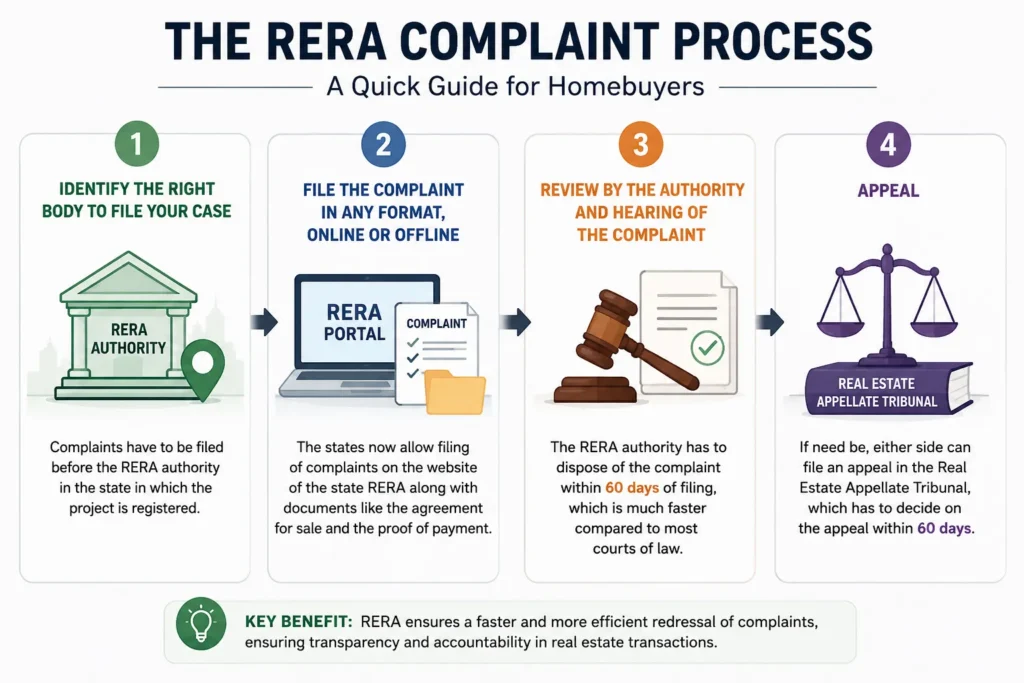
The filing of a complaint under RERA should not only be simpler and less complex but should also involve steps that are easier to follow:
- Identify the right body to file your case
Complaints have to be filed before the RERA authority in the state in which the project is registered.
- File the complaint in any format, online or offline
The states now allow filing of complaints on the website of the state RERA along with documents like the agreement for sale and the proof of payment.
- Review by the authority and hearing of the complaint
The RERA authority has to dispose of the complaint within 60 days of filing, which is much faster compared to most courts of law.
- Appeal
If need be, either side can file an appeal in the Real Estate Appellate Tribunal, which has to decide on the appeal within 60 days.
The 60-day period is probably one of the most practical RERA benefits because complaints that would take several years in civil court will now take only months.
Project Verification: How to Check RERA Registration
Checking the RERA status of your project should take only a few minutes and should never be overlooked, regardless of how legitimate the developer may sound in discussion.
- Log on to your state’s official RERA website.
- Enter the name of the project, the name of the developer, or the registration number of the project that the developer has issued to you.
- Verify that the project is still registered, check the date of completion of the project, and see if there are any complaints or penalties against the project.
- Make sure that the unit that you’re buying is within the registered project premises, as sometimes the developer registers a certain phase and then sells units from unregistered future phases as well.
At a national level, more than 1.38 lakh real estate projects had been registered under RERA in India till early 2025.
Penalties for Builders: What Non-Compliance Actually Costs
The effectiveness of the penalties under RERA depends on them being severe enough. Builders that do not register projects that need to be registered and those that breach any of the requirements are liable to a penalty of up to 10% of the estimated cost of the project.
Should the builder continue to ignore their obligations following an earlier penalty, the Act provides for the imprisonment of the promoter for up to three years, alongside more fines.
The above are not merely examples but have been imposed by RERA regulators in states where developers have breached timelines and escrow funds. In other words, these are actual penalties for average, unregistered projects, which give buyers nothing to hope for at all.
Buyer Errors While Evaluating RERA Registered Projects
- Thinking that registration alone will lead to a positive result
Registration shows that the project follows the law and doesn’t assure high-quality construction or reliability of the developer in other matters.
- Not verifying the registration of a certain unit or phase
Certain buyers verify the project’s general name but don’t check if their exact unit was covered.
- Overlooking the history of complaints posted on the RERA website
Each registered project has a section with complaints filed before, but the majority of buyers fail to look at it.
- Delaying the complaint regarding the delay for too long
The buyers usually waste some time waiting for the builder to solve the problem instead of making the complaint via the legally quicker procedure of RERA.
- Failing to keep the documents related to the payments and purchase
Having all the information about the payments organised helps to go through the complaint process faster.
Expert Tips: Making the Most of RERA Benefits
Professional property lawyers and buyers consider the RERA registration only as the beginning of the due diligence process.
They always check the registration number on the state website, analyse the disclosed completion date together with the real construction on-site, and keep all the records about the payments and communication with the builder.
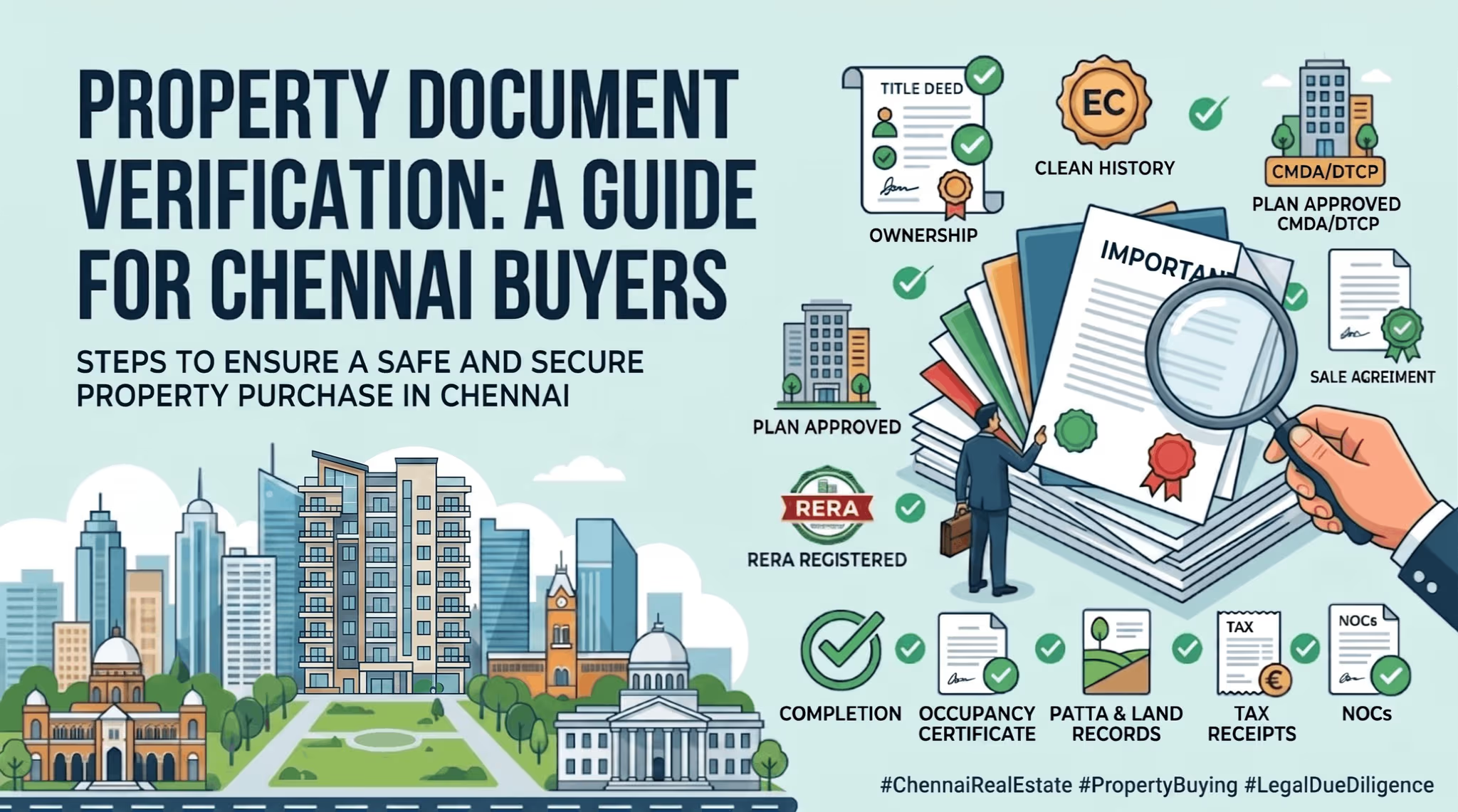
When buying a property, maintaining complete and accurate documentation is essential. Buyers should carefully verify documents such as the sale agreement, title documents, approvals and encumbrance certificate before making payments. Knowing how to verify property documents in Chennai can help you identify discrepancies early and proceed with greater confidence.
The Importance of LML Homes Approach Towards RERA Compliance
The process of selecting among projects that are RERA-approved projects is not supposed to be complicated at all. In LML Homes, it is not complicated.
All developments by LML Homes are RERA registered. LML Homes has published their registration, layouts, completion dates and any other documentation on the portal of the state so that they can be independently verified.
There are no minimal escrow accounts, advance payments, or disclosures; these practices apply across the board in all developments of LML Homes.
For buyers looking to understand the step-by-step process to buy an apartment in Chennai, checking the project’s RERA registration is an important part of the process. LML Homes provides buyers with the transparency and information they need to make informed decisions at each stage of their apartment purchase.
To wrap up: let RERA Registration do the filtering, not the Sales Pitch
The benefit of a project that has been RERA-approved lies in the fact that it provides an individual with legal safeguards and protection against anything that might have been promised by a mere sales pitch.
To know how RERA actually helps protect the interests of buyers, the process of filing a complaint and the actual consequences faced by developers will help one realise the importance of registering projects under RERA. One must check this on the website of the state. @LML Homes Check Out Our Latest RERA Reel on Instagram
Discover RERA-registered and fully compliant projects from LML Homes now!
Frequently Asked Questions About RERA-approved Projects
Q. 1. How to find out if a project is RERA-approved?
Log in to your respective state’s RERA website and search by entering the name of the project, developer name, or the registration number of the builder provided to you.
Q. 2. Why is it necessary for projects to be RERA approved?
When a project is RERA approved, it ensures that the money paid by the buyer goes into an escrow account, the advance amount cannot exceed 10%, all project details are made public, and there is a quick way to register complaints against the builder in case the builder does not deliver on time.
Q. 3. Is it possible to lodge a complaint under RERA?
Yes. A buyer of a project which has been registered under RERA can file a complaint with the state RERA authority, which is supposed to resolve it in 60 days.
Q. 4. Are all projects required to register under RERA?
The registration of all projects that are bigger in size, such as plots which are over 500 square metres or projects having more than eight units, is mandatory. Some exceptions may be possible for already-built projects and the standalone sale of plots in some states.
Q. 5. What are the consequences of violating the RERA regulations?
Violators of the regulations may be charged with a penalty of up to 10% of the estimated cost of the project, and for non-compliance beyond a period, the violator may be jailed for up to three years along with a fine, as applicable.
Q. 6. What will be the interest rate on delayed delivery under RERA?
Consumers get an interest rate of SBI MCLR plus 2% per year on the entire amount of money deposited by them for each month’s delay. The interest rate comes out to be around 10–11%.
Q. 7. Is there an option of receiving a full refund in case my project is delayed due to RERA?
Yes. According to Section 18, in the case of delay in the possession of property after the agreed time, a consumer has the right to get back his entire amount along with interest from the builder within 45 days of making the request.
Q. 8. Is the registration process under RERA the same for all the states in India?
No. RERA is an act of the central government, but different state governments have their own regulator, portal and rules regarding the implementation of the act.
Q. 9. Can a project change its promised delivery date after getting registered under RERA?
Yes. A developer can change the completion date as specified under the RERA Act, but only under certain circumstances and must register it on the RERA portal as well.
Q. 10. Is resale of property covered under the RERA Act?
Not exactly; the RERA Act is applicable to the sale of newly developed projects. Resale transactions done between two individuals do not come under the purview of RERA, but the original project registration is still applicable to the unit.